Statistical Analysis

Chapter 4

Dr. Andrew Besmer

Statistical Analysis

Prepping Data

  • Clean up data
    • Detect Errors/Invalid Data
      • Consider reasonableness: 223 year old?
      • Did you have attention checks?
      • Participant spent 3 seconds per questions?

Prepping Data

  • Clean up data
    • Detect Errors/Invalid Data
      • Fix if possible, e.g. contact participant ask age
      • If not possible (no link to identity, failed attention check, etc…), consider removal

Prepping Data

  • Clean up data
    • Format
      • Transform "I am twenty one in Jan." -> 20
      • Better if you can constrain and guide them to valid inputs

Prepping Data

  • Coding
    • Stats tools typically need numerical data
    • No -> 0 Yes -> 1
    • Strongly Disagree -> 1 Strongly Agree -> 7
    • Be consistent
  • May be scale, ordinal or nominal
    • Examples

Prepping Data

  • Organizing data
    • Accommodate to the requirements of statistical software
      • May need to combine participant data dispersed in many systems
        • Logs
        • Surveys
        • etc…

Descriptive Statistics

  • Measures of central tendency
    • Mean
    • Median
    • Mode
  • Measures of spread
    • Range
    • Variance
    • Standard deviations

Comparing Means

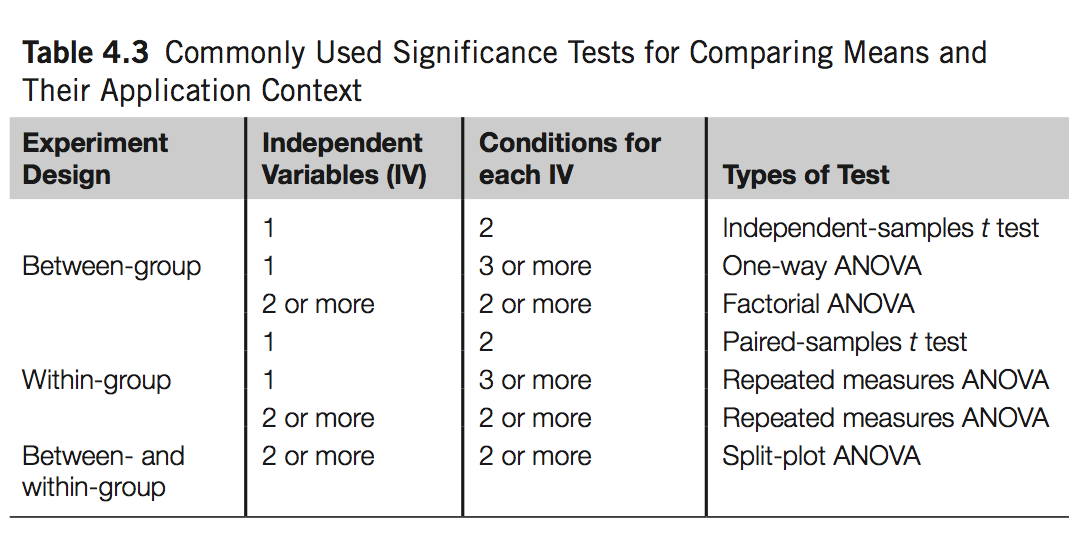
Summary of Methods
Summary of Methods

Comparing 2 Means

  • Students T-Test
  • The most widely adopted method for comparing 2 means
    • Independent-samples t test: between-group design
    • Paired-samples t test: within-group design

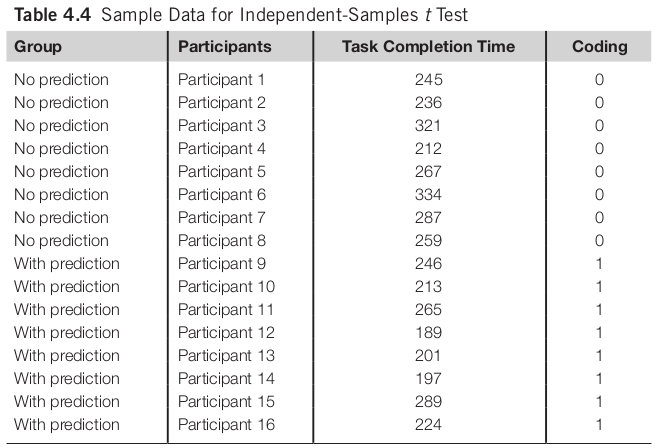
Layout of Independent Samples T Test

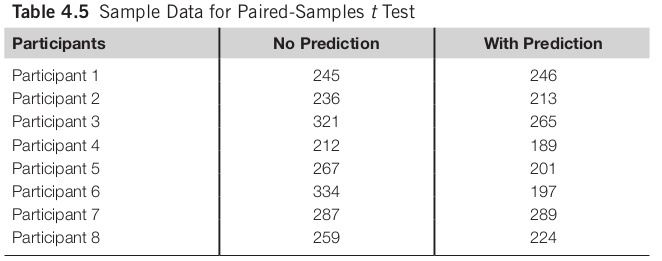
Layout of Paired Samples T Test
Comparing 2 Means

  • Interpretation of t test results:
    • Larger t value: higher probability of the null hypothesis being false
    • t value needs to be reported together with the degree of freedom and the level of significance
  • Two-tailed t test vs. one-tailed t test
    • Whether the hypothesis indicates the direction of the difference

Comparing 2 Means

An independent-samples t test suggests that there is significant difference in the task completion time between the group who used the standard word-processing software and the group who used word-processing software with word prediction functions (t(15) = 2.169, p < 0.05).

Comparing 2 or More Means

  • Analysis of variance (ANOVA)
    • Also called F tests
    • One-way ANOVA used for between-group design

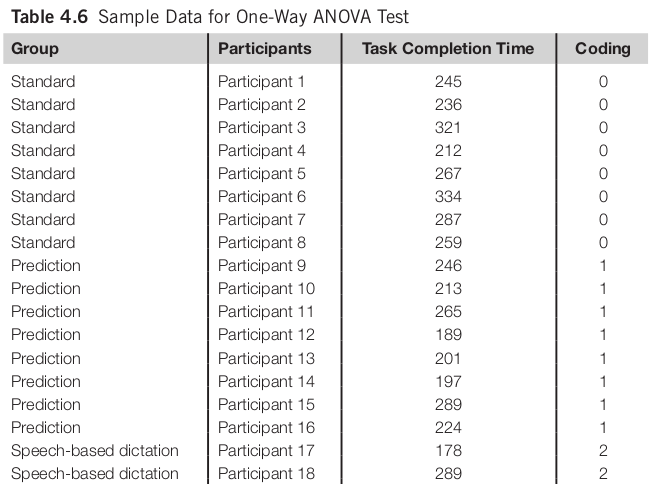
Comparing 2 or More Means

Comparing 2 or More Means
Comparing 2 or More Means

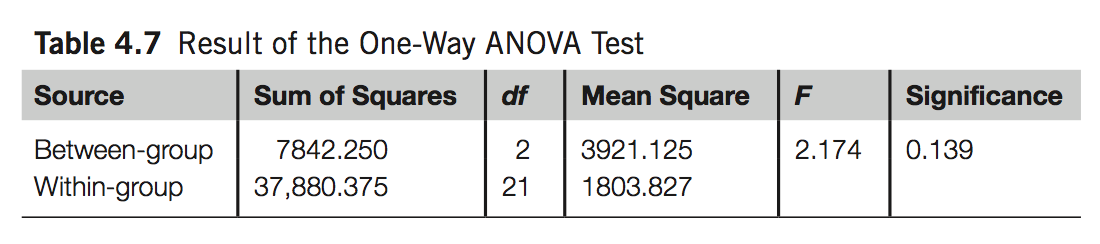
A one-way ANOVA test using task completion time as the dependent variable and group as the independent variable suggests that there is no significant difference among the three conditions (F(2, 21) = 2.174, n.s.).

Factorial ANOVA

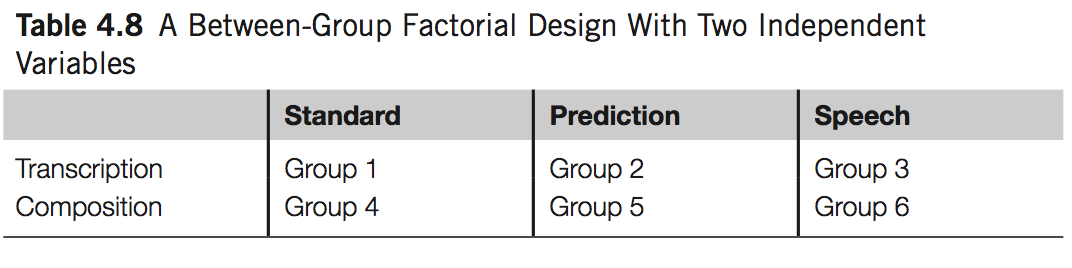
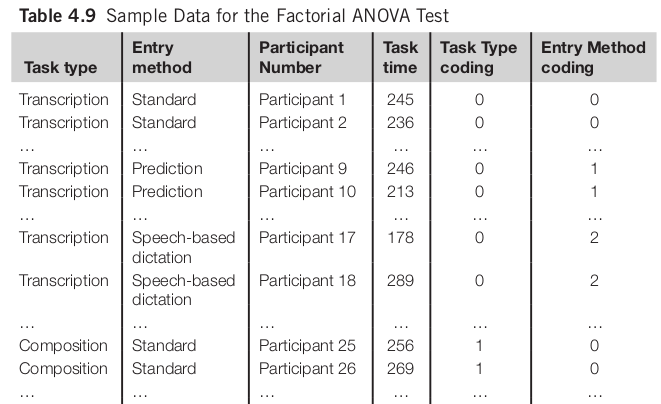
  • For between-group design
  • 2 or more independent variables involved
Factorial ANOVA
Factorial ANOVA
Factorial ANOVA

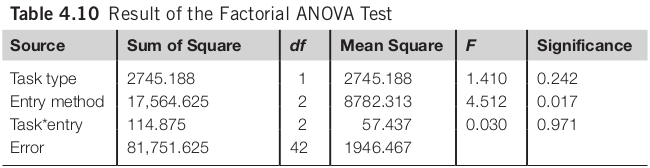
The analysis result suggests that there is no significant difference between participants who completed the transcription tasks and those who completed the composition tasks (F(1, 42) = 1.41, n.s.). There is significant difference among participants who used different text entry methods (F(2, 42) = 4.51, p < 0.05).

Repeated Measures ANOVA

  • For within-group design
  • Can investigate one or more variables
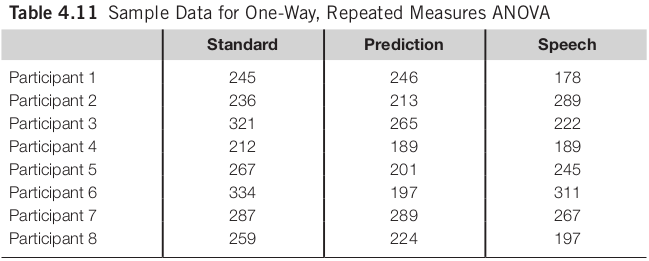
    • One Way -> One IV w/mult levels
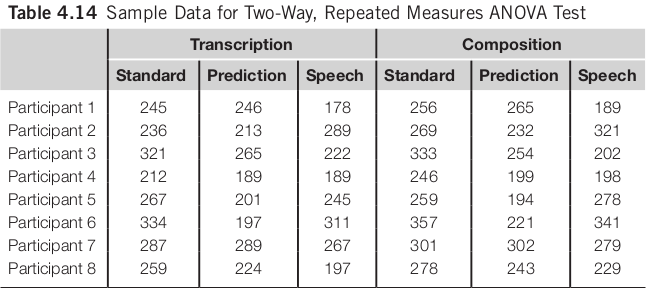
    • Two Way -> Two or More IV w/mult levels

One Way Repeated Measures ANOVA

One Way Repeated Measures ANOVA
Two Way Repeated Measures ANOVA

Two Way Repeated Measures ANOVA
Two Way Repeated Measures ANOVA
Two Way Repeated Measures ANOVA

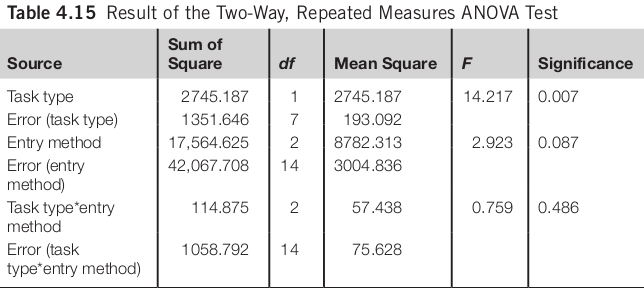
The task type has a significant impact on the time spent to complete the task (F(1, 7) = 14.217, p < 0.01). There is no significant difference among the three text entry methods (F(2, 14) = 2.923, n.s.). The interaction effect between the two independent variables is not significant either (F(2, 14) = 0.759, n.s.).

Split-Plot ANOVA

  • Involves both between-group and within-group factors
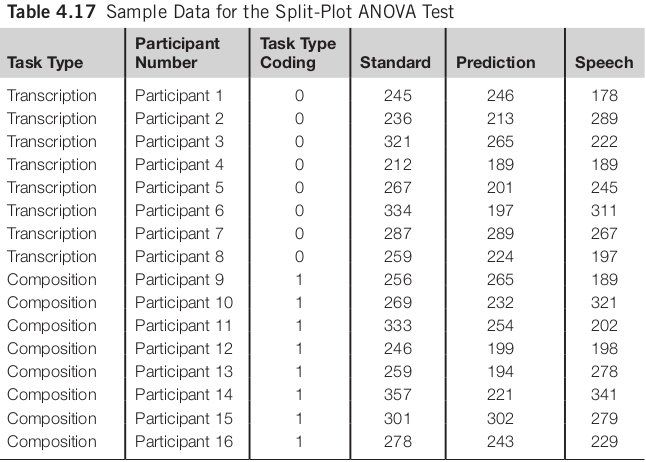
  • Between group task type, within group is entry method
    • Reduces study time/participants needed
    • Controls learning effect somewhat

Split-Plot ANOVA
Split-Plot ANOVA

  • Between Group Variable (Task Type)

Split-Plot ANOVA

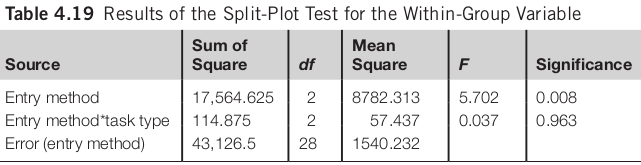
  • Within Group Variable (Entry Method)

Split-Plot ANOVA

There is no significant difference between participants who complete composition or transcription tasks (F(1, 14) = 0.995, n.s.). There is a significant difference among the three text entry methods (F(2, 28) = 5.702,p < 0.01). The interaction effect between task types and text entry methods is not significant (F(2, 28) = 0.037, n.s.).

Assumptions

  • Assumptions of t tests and F tests
    • Errors should be independent of each other
      • E.g. two investigators, one provides more instruction
    • Errors should be identically distributed
      • “Homogeneity of variance”
    • Errors should be normally distributed
      • Skewed data (positive or negative)

Non-parametric Tests

  • Non-parametric tests are used when:
    • The error is not normally distributed
    • The distances between any two data units are not equal
    • The variance of error is not equal

CHI Squared Test

  • Used to analyze categorical data
  • Table of frequency counts (contingency table)
  • Degree of freedom = ( Number of rows - 1 ) x ( Number of columns - 1 )
  • Assumptions of the test
    • Data points need to be independent
    • The sample size should not be too small
CHI Squared Test

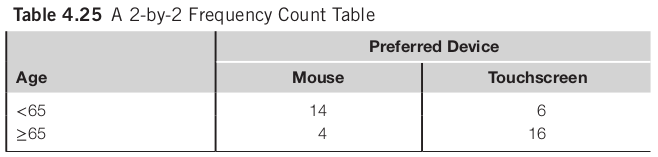
A CHI Squared Test (χ2 (1) = 10.1, p < 0.05) suggests that the probability of the difference between the rows and columns occurring by chance is less than 0.05 we therefore reject the null hypothesis and conclude that there is a relationship between age and preferred pointing device.

Non-parametric Tests to Compare Means

  • Comparing two groups of data
    • For between-group design: Mann–Whitney U test or the Wald–Wolfowitz runs test
      • Nonparametric alternative to the independent-samples t test
    • For within-group design: Wilcoxon signed ranks test
      • Nonparametric alternative to the paired-samples t test

Non-parametric Tests to Compare Means

  • Comparing three or more groups of data
    • For between-group design: Kruskal–Wallis one-way analysis of variance by ranks
      • Nonparametric alternative to the one-way ANOVA
    • For within-group design: Friedman’s two-way analysis of variance test
      • Nonparametric alternative to the Repeated Measures ANOVA

Identify Relationships

  • Correlation
    • Two factors are correlated if there is a relationship between them
  • Most commonly used test is Pearson’s product moment correlation coefficient
  • Pearson’s r: ranges between -1 to 1
  • Pearson’s r square represents the proportion of the variance shared by the two variables

Identify Relationships

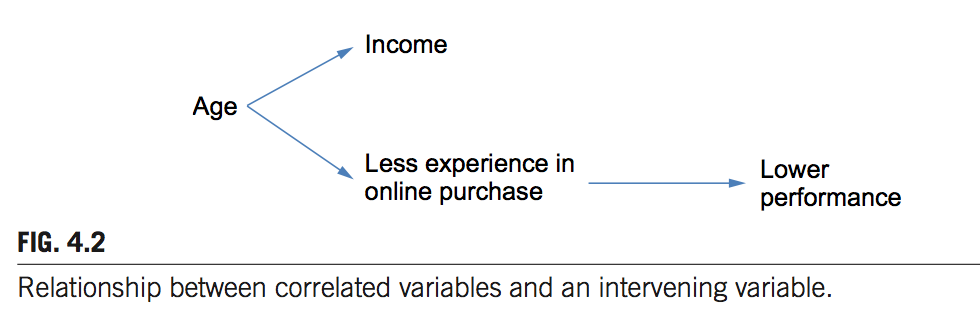
  • Correlation does not imply causal relationship
Identify Relationships

  • Regression
    • Can investigate the relationship between one DV and multiple IVs
  • Regression is used for:
    • Model construction
    • Prediction
  • Different regression procedures
    • Simultaneous
    • Hierarchical

Simultaneous Regression

  • To find the relationship between DV and IVs as a group
  • What percentage of variance does the set of IV’s explain in terms of the DV?
  • All IVs entered simultaneously

Simultaneous Regression

Simultaneous Regression

There is a significant relationship between task completion time and the independent variables as a group (F(4, 59) = 41.147, p < 0.001). Age, computer experience, target size, and navigation distance explain a total of 73.6% of the variance in task completion time.

Hierarchical Regression

  • To find the relationship between DV and each IV
  • Each IV entered one at a time
  • Order of IVs depends on the predefined theoretical model
    • Important IVs
    • Covariates

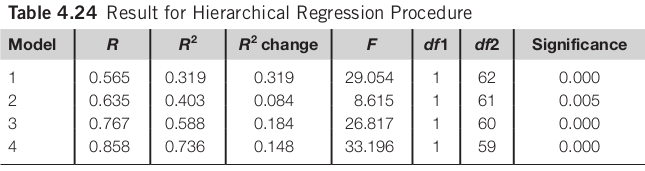
Hierarchical Regression

Hierarchical Regression

Target size explains a significant percentage of the variance (31.9%) in task completion time (F(1, 62) = 29.054, p < 0.001). Navigation distance also has a significant impact on task completion time (F(1, 61) = 8.615, p < 0.01). … …

Questions

Questions

Questions?